What's New

Stay up to date with innovations in medical education and the latest research trends.

Innosonian News is a central hub connecting the present and future of CPR education and medical technology.
From company updates and industry trends to the latest research findings and guideline updates, instructors, healthcare professionals,
and partners can quickly access the information they need in one place.

How to Perform CPR
Global Insights

How to Perform CPR

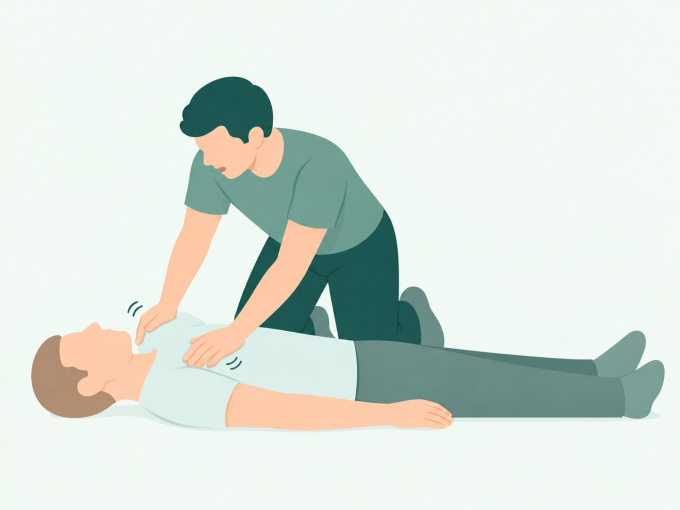
ADULT CPR · A GUIDE FOR BYSTANDERS How to PerformCPR When someone suddenly collapses, your actions can save a life. If someone suddenly collapses, is unresponsive and is not breathing normally, call 119 and start chest compressions. Occasional gasping or abnormal breathing can also be a sign of cardiac arrest. Do not delay chest compressions to check for a pulse. STEP 01 Check for safety and responsiveness Check for hazards such as traffic or electricity. Gently tap both shoulders and ask loudly, “Are you okay?” If there is no response, shout for help immediately. 119 STEP 02 Call 119 and ask for an AED Point to a specific bystander and ask them to call 119 and bring an automated external defibrillator (AED). If you are alone, put your phone on speaker and follow the emergency dispatcher’s instructions. Check breathing for no more than 10 seconds. If the person is not breathing normally or is only gasping, start chest compressions. STEP 03 Push hard and fast in the center of the chest Kneel beside the person, who should be lying on their back on a firm, flat surface. Place the heel of one hand in the center of the chest, on the lower half of the breastbone. Place your other hand on top and interlock your fingers. Keep your elbows straight and your shoulders directly above your hands. Compress about 5 cm deep at a rate of 100–120 compressions per minute. Avoid compressing deeper than 6 cm. 100–120/minCompression rate About 5 cmCompression depth Allow the chest to fully recoil after each compression. Keep the heel of your hand in contact with the chest without leaning on it. Minimize interruptions. STEP 04 Use the AED as soon as it arrives Turn it on and follow the voice prompts. Expose the chest and dry it if wet, then attach the pads as shown in the diagrams on them. If another rescuer is present, continue chest compressions while the AED is being prepared. Make sure no one touches the person while the AED analyzes the rhythm or delivers a shock. Resume chest compressions immediately after a shock, or when the AED says no shock is needed. How long should you continue compressions? Continue until emergency responders arrive and take over, or the person becomes responsive and starts breathing normally. If someone can help, switch rescuers about every 2 minutes and keep interruptions brief. If you cannot give rescue breaths For an adult who suddenly collapses, continue chest compressions alone. If you are trained and able to give rescue breaths, repeat cycles of 30 chest compressions and 2 rescue breaths. This guide covers sudden cardiac arrest in adults. Rescue breaths are especially important for children, infants and people who have drowned. Follow the emergency dispatcher’s instructions. The illustrations are simplified for clarity. In an emergency, follow the 119 dispatcher’s instructions and the AED voice prompts. References · 2025 Korean Guidelines for Cardiopulmonary Resuscitation / 2025 AHA Adult Basic Life Support Guidelines KDCA Guidelines·AHA Adult Basic Life Support This article was written with AI assistance. AI-generated concept image featuring BRAYDEN; the product depicted is separate fr|om the equipment used in the study.
Adding VR to CPR Training: Did Performance Improve?
Research Trends

Adding VR to CPR Training: Did Performance Improve?

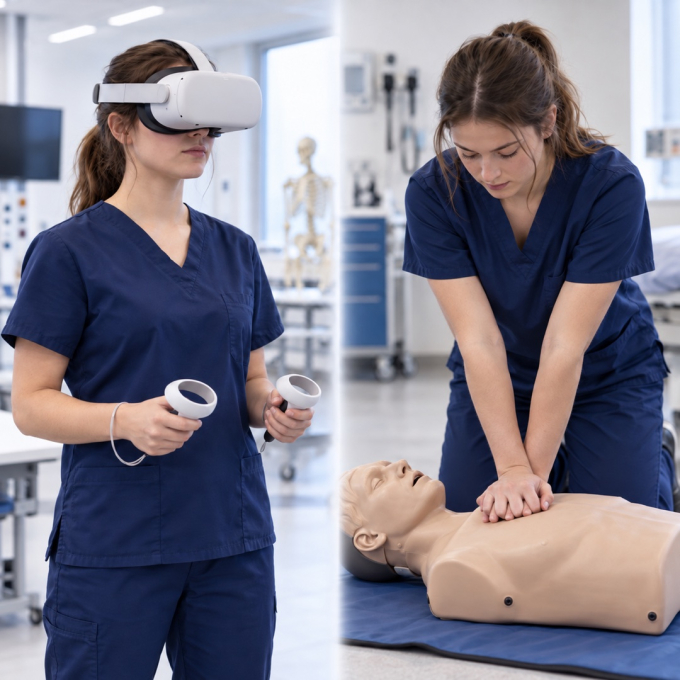
Adding VR to CPR Training: Did Performance Improve? | INNOSONIAN Adding VR to CPR Training: Did Performance Improve? What changes when students practise in VR first? Could practising CPR in virtual reality before moving on to a manikin help students perform with greater confidence? Researchers in Spain explored this question by examining both students’ learning experiences and their performance during practical training. Comparing VR plus manikin practice with manikin practice alone The study involved fourth-year nursing students at a Spanish public university during the 2024–2025 academic year. Researchers randomly assigned 246 students to two groups. One group completed VR training followed by manikin practice, while the other practised with manikins alone. After training, students reported their confidence, satisfaction, and views on the usefulness and usability of the training tools. CPR performance was assessed in teams. A total of 211 students completed all questionnaires: 107 in the VR group and 104 in the manikin-only group. Positive learning experiences did not translate into better performance Students in the VR group gave higher ratings for ease of learning, usefulness, satisfaction, and ease of use. Their response to the learning experience was positive. However, the VR group did not show a statistically significant improvement in confidence compared with the manikin-only group. The researchers also found no statistically significant difference in CPR team performance between the groups. These findings remained unchanged after the analysis accounted for similarities between students within the same practice team. The researchers’ conclusion Adding VR to CPR training was well received by students, but it did not produce a statistically significant improvement in confidence or CPR team performance compared with manikin practice alone. Nevertheless, the researchers considered VR a potentially useful complement to face-to-face simulation. Source Raurell-Torredà M, et al. Effectiveness of immersive virtual reality in undergraduate nursing students for cardiopulmonary resuscitation training: A randomized controlled trial. Nurse Education Today. Published online 28 August 2026. Article 107379. DOI: 10.1016/j.nedt.2026.107379 · Study abstract and citation This article was written with AI assistance. AI-generated concept image featuring BRAYDEN; the product depicted is separate fr|om the equipment used in the study.  
What If AI Could Flag CPR Mistakes as They Happen?
Research Trends

What If AI Could Flag CPR Mistakes as They Happen?

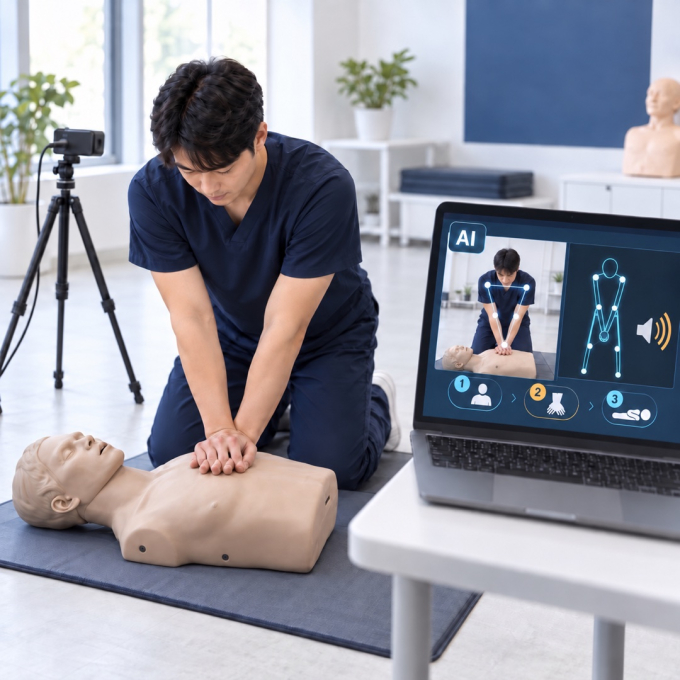
What If AI Could Flag CPR Mistakes as They Happen? | INNOSONIAN What If AI Could Flag CPR Mistakes as They Happen? Could immediate guidance help people learn CPR? Could a computer recognise when a learner’s posture or sequence of CPR actions departs fr|om the correct procedure and provide immediate guidance? Researchers in Taiwan developed a system that uses AI to analyse camera footage of CPR practice. The AI recognises the learner’s posture and sequence of actions, then provides feedback through on-screen prompts and sound. The study investigated whether this technology could support learning as well as recognise movements. fr|om camera footage to on-screen and audio feedback The system divides incoming video into short clips and analyses body positions and movements to identify the CPR action being performed. When the learner’s posture or sequence of actions deviates fr|om the standard procedure, the system provides visual and audio prompts. This allows learners to check their posture and follow the procedure while practising. An instructor assessed performance in 60 participants The study involved 60 participants divided into two groups of 30. The full experiment took approximately eight hours, covering a pre-test, instructor-led teaching, group practice, and a post-test. Researchers compared participants who practised with the AI feedback system with those who received conventional training. A CPR instructor assessed performance without knowing which training group each participant belonged to. The instructor examined whether participants performed the actions in the correct order and how long they hesitated during the procedure. Higher performance scores and lower mental effort After training, participants in the AI feedback group achieved an average performance score of 89, compared with 72 in the conventional training group. The difference was statistically significant. These scores reflected the correctness of the action sequence and hesitation during performance. Participants in the AI feedback group also reported lower mental effort while learning and greater satisfaction with their training experience. What the findings suggest The findings suggest that immediate feedback based on posture and action recognition may help learners acquire CPR skills. The study tested camera-based analysis and visual and audio prompts together, so it could not identify which component accounted for the difference. It also did not establish that AI feedback was faster or more effective than an instructor’s feedback. These were early findings fr|om performance assessed immediately after training in a controlled setting. Source Chiu MC, Huang ZH, Kao MC. Development of a real-time multimedia feedback system for CPR training based on human pose estimation and skeleton-based action recognition. Multimedia Tools and Applications. 2026;85:733. DOI: 10.1007/s11042-026-21896-1 · Study abstract and citation This article was written with AI assistance. AI-generated concept image featuring BRAYDEN; the product depicted is separate fr|om the equipment used in the study.
Korea’s Acute Cardiac Arrest Survival Rate Continues to Rise
Research Trends

Korea’s Acute Cardiac Arrest Survival Rate Continues to Rise

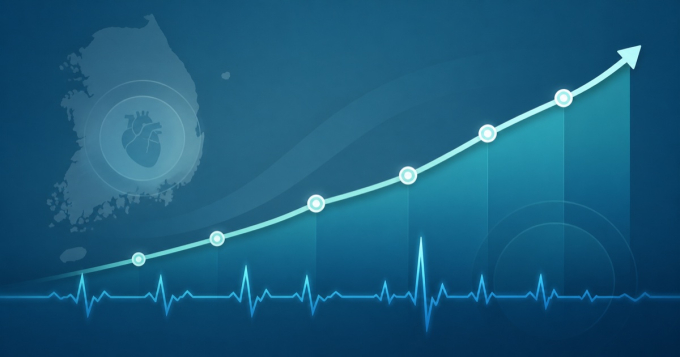
16,045 cases surveyed in the first half of 2025 On June 18, 2026, the Korea Disease Control and Prevention Agency (KDCA) published its first-half 2025 acute cardiac arrest statistics. The survey covers patients who experienced acute cardiac arrest between January and June 2025 and were transported to a medical facility by a 119 ambulance crew. First-half figures at a glance First half of 2024 → first half of 2025 Survival rate9.2% → 9.4%+0.2 pp Bystander CPR rate30.2% → 32.9%+2.7 pp Neurological recovery6.4% → 6.2%−0.2 pp Of the 16,229 acute cardiac arrest cases recorded during this period, 16,045 were included in the completed survey, for a completion rate of 98.9%. KDCA compiles the occurrence, treatment, and survival outcomes of acute cardiac arrest through hospital medical records. Survival rate 9.4%; neurological recovery 6.2% There were 1,501 patients discharged alive, resulting in a survival rate of 9.4%. This was 0.2 percentage points higher than the 9.2% recorded in the first half of 2024. A total of 1,001 patients were discharged with neurological function restored to a level generally compatible with independent daily living. The neurological recovery rate was 6.2%, 0.2 percentage points lower than the 6.4% recorded in the first half of 2024. In KDCA statistics, neurological recovery generally refers to a Cerebral Performance Category (CPC) score of 1 or 2. Bystander CPR rate reaches 32.9% Bystanders performed CPR in 4,500 cases, giving a bystander CPR rate of 32.9%. This was 2.7 percentage points higher than the 30.2% recorded in the first half of 2024. In this survey, “bystander” excludes on-duty ambulance crew members and healthcare professionals. When bystander CPR was performed, the survival rate was 15.3% and the neurological recovery rate was 11.5%. When it was not performed, the rates were 5.6% and 3.3%, respectively. The two groups differed by 2.7 times in survival and 3.5 times in neurological recovery.1 Why has the bystander CPR rate increased? This survey did not separately analyse why the rate increased. The 2.7 percentage-point rise fr|om the first half of 2024 therefore cannot be attributed to a single cause. The 2025 Korean CPR Guidelines do note that bystander CPR rates have gradually increased since dispatcher-assisted CPR was introduced. They also identify practical training, repeated training, recent training, and community education as factors that can help witnesses attempt CPR. These are long-term background factors in Korea; they are not an analysis directly explaining the change between these two half-year periods. 47.0% of cases occurred at home In the first half of 2025, 77.6% of acute cardiac arrests were caused by disease, including cardiac causes such as myocardial infarction and arrhythmia and conditions such as stroke. Non-disease causes, including falls, transport incidents, and hanging, accounted for 22.0%. Non-public places, including homes and care facilities, accounted for 65.6% of cases; public places, including commercial facilities and roads, accounted for 18.6%. Homes were the single most common location, accounting for 47.0% of all cases. How to read these statistics In this survey, the survival rate is the proportion of acute cardiac arrest patients whose emergency-department or inpatient outcome was recorded as discharge, self-discharge, or transfer. The bystander CPR rate is the proportion of patients who received CPR before hospital arrival fr|om someone other than an on-duty ambulance crew member or healthcare professional. These figures cover the first half of 2025. KDCA is scheduled to publish the full-year 2025 acute cardiac arrest survey results in December 2026. 1 These figures directly compare outcomes for patients who received CPR with those for patients who did not. The groups were not matched for patient condition or place of arrest, so the entire difference cannot be attributed to CPR alone. Sources KDCA, Acute Cardiac Arrest Survival Rate Continues to Rise — June 18, 2026 KDCA and Korean Association of Cardiopulmonary Resuscitation, 2025 Korean CPR Guidelines
Singapore’s 2026 BCLS and AED Guidelines: What Has Changed?
Emerging Markets

Singapore’s 2026 BCLS and AED Guidelines: What Has Changed?

No major overall change fr|om the 2021 edition Singapore Medical Journal published Singapore Basic Cardiac Life Support and Automated External Defibrillation Guidelines 2026 in July 2026. This is a guideline describing Singapore’s BCLS and AED procedures, not a clinical study of a specific patient group. Compared with the 2021 guideline fr|om the Singapore Resuscitation and First Aid Council (SRFAC), there are no major changes to CPR performance overall. Changes were made to paediatric CPR and foreign body airway obstruction in conscious adults and children. Key changes in 2026 The paediatric compression-to-ventilation ratio is presented as 15:2, replacing the previous use of 30:2 or 15:2. For infant chest compressions, either the two-thumbs-encircling technique or the one-hand method is recommended. Back blows have been reintroduced into the algorithm for conscious adults and children with foreign body airway obstruction. Gasping may be a sign of cardiac arrest The guideline describes recognition of cardiac arrest as one of the most difficult parts of BCLS education and assessment. Studies cited in the guideline found gasping in up to 40% of patients during the early phase of sudden cardiac arrest. Lay rescuers and healthcare providers should learn to recognize gasping as a sign of cardiac arrest rather than normal breathing and begin CPR immediately. If a person is unresponsive and normal breathing is absent or uncertain, cardiac arrest should be presumed. A brief seizure may also occur at the onset; once it stops, responsiveness and normal breathing should be checked and CPR started if breathing is absent or uncertain. Dispatcher-assisted CPR and myResponder Dispatcher-assisted CPR (DACPR) is associated with higher bystander CPR rates and better survival after cardiac arrest. When callers report an unresponsive person with absent or abnormal breathing, Singapore’s call-takers instruct them to stay on the line and provide CPR guidance. For adults, instructions focus on compression-only CPR; for paediatric arrests, chest compressions with ventilation are advised. Singapore’s myResponder app alerts community first responders within 400 metres and guides them to retrieve the nearest AED while going to the scene. Why compression-only CPR is emphasized for lay rescuers The guideline notes that most sudden out-of-hospital cardiac arrests occur in adults and are cardiac in origin. Because oxygen remains in the blood for the first few minutes, uninterrupted chest compressions are more important than rescue breaths at the start. Two observational studies cited in the guideline found improved adult out-of-hospital cardiac arrest survival after compression-only CPR was introduced in the community. In a Singapore study, only 14.9% of participants trained in mouth-to-mouth ventilation could perform at least five effective ventilations of 400 mL or more six months later, and 3.7% could perform at least ten within five minutes. Another 14.9% only mimicked the ventilation. SRFAC therefore recommends that lay-rescuer CPR training focus on recognizing cardiac arrest, calling an ambulance, and delivering high-quality manual chest compressions. Public access defibrillator programmes remain a priority The 2025 ILCOR Consensus on Science with Treatment Recommendations strongly recommends public access defibrillator (PAD) programmes. The guideline reports that studies in residential areas, airports, subways, casinos, and sports facilities associate PAD programmes with improved out-of-hospital cardiac arrest survival. In Singapore, the Singapore Heart Foundation and Singapore Civil Defence Force provide an AED owner’s guide covering AED use, training, installation, and maintenance. What Korean readers should distinguish The 995 emergency number, call-taker breathing checks, myResponder app, and course arrangements reflect Singapore’s system. In Korea, the latest Korean CPR guidelines and emergency medical system apply. The way Singapore connects cardiac-arrest recognition, immediate dispatcher guidance, community first responders, AED access, and repeatable layperson training is nevertheless a useful point of reference for Korean educators. This is INNOSONIAN’s editorial interpretation based on the guideline. For training use This article introduces key changes and re-emphasized points in the Singapore guideline; it does not replace Korean medical guidance. Follow the latest local guidelines and advice fr|om emergency medical professionals in training and real emergencies. Paper information Swee Han Lim, Benjamin Sieu-Hon Leong, Jun Hao Loke, Kee Chong Ng. Singapore Basic Cardiac Life Support and Automated External Defibrillation Guidelines 2026. Singapore Medical Journal. 2026;67(7):406–413. PubMed · PMID 42507342 DOI: 10.4103/singaporemedj.SMJ-2026-319
Beijing Establishes Standards for AED Placement and Management in Public Places
Emerging Markets

Beijing Establishes Standards for AED Placement and Management in Public Places

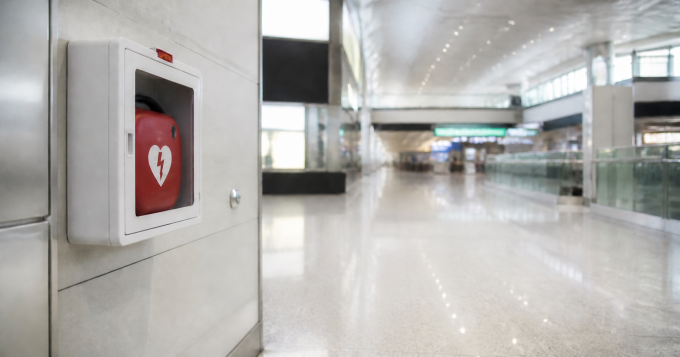
Effective October 1, 2026 On June 30, 2026, the Beijing Municipal Administration for Market Regulation issued local standard DB11/T 2564-2026, Code for the Allocation and Management of Automated External Defibrillators in Public Places. The standard takes effect on October 1, 2026. According to the Beijing municipal government, it covers AED placement plans and installation, signs, equipment maintenance, and training. The scope therefore extends beyond the number of AEDs supplied to the operating system needed to find and use a device in an emergency. Main areas covered AED placement plans and priority locations Installation points and consistent signs Inspection and maintenance of equipment and consumables CPR and AED training A five-minute round trip is recommended in crowded locations Residential areas, urban rail and transport facilities, schools, care facilities, sports and cultural venues, large commercial facilities, and parks are listed as priority locations because many people gather there or the risk of an incident is higher. At these locations, AEDs should be placed so that the round-trip walking time to retrieve one is under five minutes. In healthcare facilities, areas where specialist staff may not arrive immediately should allow an AED to be retrieved within a three-minute round trip. The standard also covers wayfinding: AED locations should be marked on public-place floor plans, with consistent and highly visible signs at main entrances and installation points. Management and training after installation AEDs installed in public places and shared residential spaces should be available for citizens to use free of charge. If a location cannot remain open 24 hours, its available hours should be displayed. The installing organization must appoint a responsible department and person, and promptly replace consumables approaching their expiry date or used in an incident. Inspection and maintenance records should be kept for at least two years. Regular training includes first-aid procedures, compression-only CPR, and AED operation. Primary and secondary schools are asked to include AED-related first-aid knowledge and operation in safety and emergency education. Points for Korean educators and facility operators This is a Beijing local standard and does not apply directly to Korea. It is nevertheless a useful example of assessing AED access through reach time, signs, hours of availability, maintenance responsibility, and training, rather than device numbers alone. INNOSONIAN notes that this standard does not validate a particular training method or product. Institutions in Korea should first confirm the local guidelines and operating standards that apply to them. Editor’s note “Is there an AED?” and “Can it be found and used when needed?” are different operating questions. This standard is an overseas example showing why signs, inspection, and training should be reviewed together with placement. Sources Beijing Municipal Administration for Market Regulation, Local Standard Announcement No. 11 (2026) — June 30, 2026 Beijing Municipal Government, Beijing issues local standard for AED allocation and management — July 9, 2026
International Overdose Awareness Day: Opioid Overdose and Emergency Response
Global Insights

International Overdose Awareness Day: Opioid Overdose and Emergency Response

Every August 31 International Overdose Awareness Day is observed every August 31. The 2026 campaign theme, 25 Years On. Still Needed., calls for remembrance of people who have lost their lives to overdose and continued action on prevention. The day is an opportunity to view overdose not only as an individual issue, but as a public-health issue requiring prevention, treatment, and emergency response. What are opioids? Opioids are a class of strong pain-relieving medicines. They include morphine, oxycodone, fentanyl, and tramadol used in healthcare, as well as illicit substances such as heroin. These substances can reduce pain while also suppressing the brain functions that control breathing. Taking more than the body can tolerate may make breathing very slow or stop it altogether. WHO identifies three common warning signs of suspected opioid overdose: Common warning signs identified by WHO Very small pupils Loss of consciousness Difficulty breathing Korea and North America have different contexts Korea has not experienced an illicit opioid crisis on the scale seen in the United States or Canada. A Korean analysis of drug-related deaths based on data fr|om 2011 to 2021 explains that illicit use of heroin, methadone, and opium was rare in Korea, so the analysis focused on medical opioids. In contrast, opioid overdose is treated as a major public-health issue in the United States and Canada. Official North American statistics for 2024 United States: Opioids were involved in 54,045 drug-overdose deaths, or 16.0 deaths per 100,000 people. More than one drug may have been involved in a death. Canada: There were 7,313 deaths due to opioid toxicity, an average of about 20 deaths per day. Why opioid overdose is connected to BLS An opioid overdose first slows breathing and can progress to respiratory arrest. When breathing stops and oxygen is no longer delivered, cardiac arrest can follow. Opioid-overdose response is therefore directly connected to basic life support (BLS), which supports breathing and circulation. The American Heart Association’s 2025 guidance explains that airway management, ventilatory support, and naloxone are important in opioid-associated respiratory arrest. If cardiac arrest is suspected, high-quality CPR including ventilation should begin; naloxone must not delay or interfere with CPR. Naloxone can temporarily reverse opioid effects and help restore breathing, but it does not replace chest compressions or ventilatory support. If a person is unresponsive and not breathing normally, activate the emergency medical system and start BLS immediately. Access to naloxone differs by country Countries where opioid overdose occurs more frequently operate different systems to make naloxone available sooner. United States: In 2023, the FDA approved the first over-the-counter naloxone nasal spray. Some products can be purchased without a prescription in pharmacies, convenience stores, and grocery stores. Canada: Most pharmacies can provide take-home naloxone kits without a prescription, and some provinces and territories provide them free of charge. United Kingdom: Naloxone is a prescription medicine, but drug-treatment services and designated healthcare and public-safety workers can provide take-home kits without an individual prescription. In an emergency, anyone can use naloxone that is available. Why New York City recommends keeping naloxone near AEDs The New York City Department of Health recommends that organizations and businesses keep shared naloxone in a location that is easy to find in an emergency, such as near a first-aid kit or an AED. This does not mean distributing naloxone and AEDs as one kit; it means improving access so both can be found quickly when needed. NYC Health lists locations for free naloxone kits, including pharmacies, opioid-overdose prevention programmes, and 24-hour public-health vending machines. In 2026, its “Just in Case” campaign also promoted free mail delivery and online education. Scope of this article This is public-health information based on WHO materials and does not provide personal diagnosis or treatment instructions. In an emergency involving reduced consciousness or breathing difficulty, seek professional emergency help immediately. Sources International Overdose Awareness Day — 2026 campaign and August 31 information World Health Organization, Opioid overdose — updated August 29, 2025 US CDC, Drug Overdose Deaths in the United States, 2023–2024 Public Health Agency of Canada, Opioid toxicity deaths American Heart Association, 2025 CPR & ECC Guidelines: Opioids US FDA, first over-the-counter naloxone nasal spray Health Canada, Naloxone UK Department of Health and Social Care, Supplying take-home naloxone without a prescription NYC Health, Naloxone NYC Health, “Just in Case” campaign
TOP
close