What's New

Stay up to date with innovations in medical education and the latest research trends.

Innosonian News is a central hub connecting the present and future of CPR education and medical technology.
From company updates and industry trends to the latest research findings and guideline updates, instructors, healthcare professionals,
and partners can quickly access the information they need in one place.

Adding VR to CPR Training: Did Performance Improve?
Research Trends

Adding VR to CPR Training: Did Performance Improve?

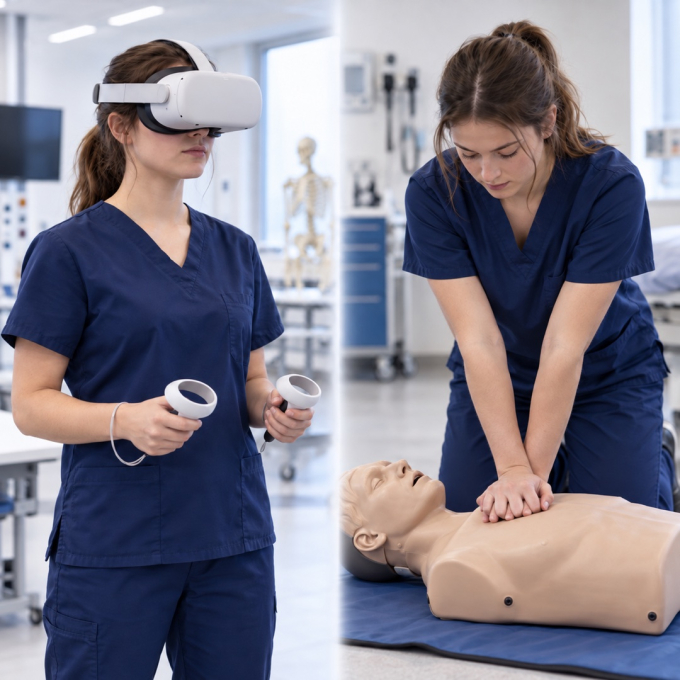
Adding VR to CPR Training: Did Performance Improve? | INNOSONIAN Adding VR to CPR Training: Did Performance Improve? What changes when students practise in VR first? Could practising CPR in virtual reality before moving on to a manikin help students perform with greater confidence? Researchers in Spain explored this question by examining both students’ learning experiences and their performance during practical training. Comparing VR plus manikin practice with manikin practice alone The study involved fourth-year nursing students at a Spanish public university during the 2024–2025 academic year. Researchers randomly assigned 246 students to two groups. One group completed VR training followed by manikin practice, while the other practised with manikins alone. After training, students reported their confidence, satisfaction, and views on the usefulness and usability of the training tools. CPR performance was assessed in teams. A total of 211 students completed all questionnaires: 107 in the VR group and 104 in the manikin-only group. Positive learning experiences did not translate into better performance Students in the VR group gave higher ratings for ease of learning, usefulness, satisfaction, and ease of use. Their response to the learning experience was positive. However, the VR group did not show a statistically significant improvement in confidence compared with the manikin-only group. The researchers also found no statistically significant difference in CPR team performance between the groups. These findings remained unchanged after the analysis accounted for similarities between students within the same practice team. The researchers’ conclusion Adding VR to CPR training was well received by students, but it did not produce a statistically significant improvement in confidence or CPR team performance compared with manikin practice alone. Nevertheless, the researchers considered VR a potentially useful complement to face-to-face simulation. Source Raurell-Torredà M, et al. Effectiveness of immersive virtual reality in undergraduate nursing students for cardiopulmonary resuscitation training: A randomized controlled trial. Nurse Education Today. Published online 28 August 2026. Article 107379. DOI: 10.1016/j.nedt.2026.107379 · Study abstract and citation This article was written with AI assistance. AI-generated concept image featuring BRAYDEN; the product depicted is separate fr|om the equipment used in the study.  
What If AI Could Flag CPR Mistakes as They Happen?
Research Trends

What If AI Could Flag CPR Mistakes as They Happen?

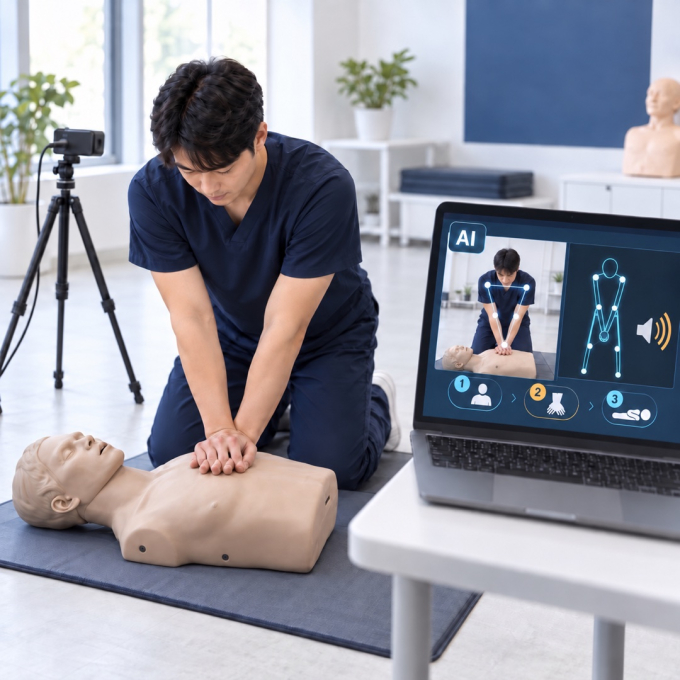
What If AI Could Flag CPR Mistakes as They Happen? | INNOSONIAN What If AI Could Flag CPR Mistakes as They Happen? Could immediate guidance help people learn CPR? Could a computer recognise when a learner’s posture or sequence of CPR actions departs fr|om the correct procedure and provide immediate guidance? Researchers in Taiwan developed a system that uses AI to analyse camera footage of CPR practice. The AI recognises the learner’s posture and sequence of actions, then provides feedback through on-screen prompts and sound. The study investigated whether this technology could support learning as well as recognise movements. fr|om camera footage to on-screen and audio feedback The system divides incoming video into short clips and analyses body positions and movements to identify the CPR action being performed. When the learner’s posture or sequence of actions deviates fr|om the standard procedure, the system provides visual and audio prompts. This allows learners to check their posture and follow the procedure while practising. An instructor assessed performance in 60 participants The study involved 60 participants divided into two groups of 30. The full experiment took approximately eight hours, covering a pre-test, instructor-led teaching, group practice, and a post-test. Researchers compared participants who practised with the AI feedback system with those who received conventional training. A CPR instructor assessed performance without knowing which training group each participant belonged to. The instructor examined whether participants performed the actions in the correct order and how long they hesitated during the procedure. Higher performance scores and lower mental effort After training, participants in the AI feedback group achieved an average performance score of 89, compared with 72 in the conventional training group. The difference was statistically significant. These scores reflected the correctness of the action sequence and hesitation during performance. Participants in the AI feedback group also reported lower mental effort while learning and greater satisfaction with their training experience. What the findings suggest The findings suggest that immediate feedback based on posture and action recognition may help learners acquire CPR skills. The study tested camera-based analysis and visual and audio prompts together, so it could not identify which component accounted for the difference. It also did not establish that AI feedback was faster or more effective than an instructor’s feedback. These were early findings fr|om performance assessed immediately after training in a controlled setting. Source Chiu MC, Huang ZH, Kao MC. Development of a real-time multimedia feedback system for CPR training based on human pose estimation and skeleton-based action recognition. Multimedia Tools and Applications. 2026;85:733. DOI: 10.1007/s11042-026-21896-1 · Study abstract and citation This article was written with AI assistance. AI-generated concept image featuring BRAYDEN; the product depicted is separate fr|om the equipment used in the study.
Korea’s Acute Cardiac Arrest Survival Rate Continues to Rise
Research Trends

Korea’s Acute Cardiac Arrest Survival Rate Continues to Rise

16,045 cases surveyed in the first half of 2025 On June 18, 2026, the Korea Disease Control and Prevention Agency (KDCA) published its first-half 2025 acute cardiac arrest statistics. The survey covers patients who experienced acute cardiac arrest between January and June 2025 and were transported to a medical facility by a 119 ambulance crew. First-half figures at a glance First half of 2024 → first half of 2025 Survival rate9.2% → 9.4%+0.2 pp Bystander CPR rate30.2% → 32.9%+2.7 pp Neurological recovery6.4% → 6.2%−0.2 pp Of the 16,229 acute cardiac arrest cases recorded during this period, 16,045 were included in the completed survey, for a completion rate of 98.9%. KDCA compiles the occurrence, treatment, and survival outcomes of acute cardiac arrest through hospital medical records. Survival rate 9.4%; neurological recovery 6.2% There were 1,501 patients discharged alive, resulting in a survival rate of 9.4%. This was 0.2 percentage points higher than the 9.2% recorded in the first half of 2024. A total of 1,001 patients were discharged with neurological function restored to a level generally compatible with independent daily living. The neurological recovery rate was 6.2%, 0.2 percentage points lower than the 6.4% recorded in the first half of 2024. In KDCA statistics, neurological recovery generally refers to a Cerebral Performance Category (CPC) score of 1 or 2. Bystander CPR rate reaches 32.9% Bystanders performed CPR in 4,500 cases, giving a bystander CPR rate of 32.9%. This was 2.7 percentage points higher than the 30.2% recorded in the first half of 2024. In this survey, “bystander” excludes on-duty ambulance crew members and healthcare professionals. When bystander CPR was performed, the survival rate was 15.3% and the neurological recovery rate was 11.5%. When it was not performed, the rates were 5.6% and 3.3%, respectively. The two groups differed by 2.7 times in survival and 3.5 times in neurological recovery.1 Why has the bystander CPR rate increased? This survey did not separately analyse why the rate increased. The 2.7 percentage-point rise fr|om the first half of 2024 therefore cannot be attributed to a single cause. The 2025 Korean CPR Guidelines do note that bystander CPR rates have gradually increased since dispatcher-assisted CPR was introduced. They also identify practical training, repeated training, recent training, and community education as factors that can help witnesses attempt CPR. These are long-term background factors in Korea; they are not an analysis directly explaining the change between these two half-year periods. 47.0% of cases occurred at home In the first half of 2025, 77.6% of acute cardiac arrests were caused by disease, including cardiac causes such as myocardial infarction and arrhythmia and conditions such as stroke. Non-disease causes, including falls, transport incidents, and hanging, accounted for 22.0%. Non-public places, including homes and care facilities, accounted for 65.6% of cases; public places, including commercial facilities and roads, accounted for 18.6%. Homes were the single most common location, accounting for 47.0% of all cases. How to read these statistics In this survey, the survival rate is the proportion of acute cardiac arrest patients whose emergency-department or inpatient outcome was recorded as discharge, self-discharge, or transfer. The bystander CPR rate is the proportion of patients who received CPR before hospital arrival fr|om someone other than an on-duty ambulance crew member or healthcare professional. These figures cover the first half of 2025. KDCA is scheduled to publish the full-year 2025 acute cardiac arrest survey results in December 2026. 1 These figures directly compare outcomes for patients who received CPR with those for patients who did not. The groups were not matched for patient condition or place of arrest, so the entire difference cannot be attributed to CPR alone. Sources KDCA, Acute Cardiac Arrest Survival Rate Continues to Rise — June 18, 2026 KDCA and Korean Association of Cardiopulmonary Resuscitation, 2025 Korean CPR Guidelines
TOP
close