Global Insights
International Overdose Awareness Day: Opioid Overdose and Emergency Response
Every August 31
International Overdose Awareness Day is
observed every August 31. The 2026 campaign theme, 25 Years On. Still Needed., calls for
remembrance of people who have lost their lives to overdose and continued action on prevention.
The day is an opportunity to view overdose not only as an individual issue, but as a
public-health issue requiring prevention, treatment, and emergency response.
What are opioids?
Opioids are a class of strong pain-relieving medicines. They include morphine,
oxycodone, fentanyl, and tramadol used in healthcare, as well as illicit substances such as heroin.
These substances can reduce pain while also suppressing the brain functions that
control breathing. Taking more than the body can tolerate may make breathing very slow or stop it
altogether. WHO identifies three common warning signs of suspected opioid overdose:
Common warning signs identified by WHO
Very small pupils
Loss of consciousness
Difficulty breathing
Korea and North America have
different contexts
Korea has not experienced an illicit opioid crisis on the scale seen in the United
States or Canada. A Korean analysis of drug-related deaths based on data fr|om 2011 to 2021 explains that
illicit use of heroin, methadone, and opium was rare in Korea, so the analysis focused on medical opioids.
In contrast, opioid overdose is treated as a major public-health issue in the United
States and Canada.
Official North American statistics for 2024
United States: Opioids were involved in 54,045 drug-overdose
deaths, or 16.0 deaths per 100,000 people. More than one drug may have been involved in a death.
Canada: There were 7,313 deaths due
to opioid toxicity, an average of about 20 deaths per day.
Why opioid overdose is connected
to BLS
An opioid overdose first slows breathing and can progress to respiratory arrest.
When breathing stops and oxygen is no longer delivered, cardiac arrest can follow. Opioid-overdose response
is therefore directly connected to basic life support (BLS), which
supports breathing and circulation.
The American Heart Association’s 2025 guidance explains that airway management,
ventilatory support, and naloxone are important in opioid-associated respiratory arrest. If cardiac arrest
is suspected, high-quality CPR including ventilation should begin; naloxone must not delay or interfere with
CPR.
Naloxone can temporarily reverse opioid effects and help restore breathing, but it
does not replace chest compressions or ventilatory support. If a person is unresponsive and not breathing
normally, activate the emergency medical system and start BLS immediately.
Access to naloxone differs by
country
Countries where opioid overdose occurs more frequently operate different systems to
make naloxone available sooner.
United States: In 2023, the FDA approved the first
over-the-counter naloxone nasal spray. Some products can be purchased without a prescription in
pharmacies, convenience stores, and grocery stores.
Canada: Most pharmacies can provide
take-home naloxone kits without a prescription, and some provinces and territories provide them free
of charge.
United Kingdom: Naloxone is a
prescription medicine, but drug-treatment services and designated healthcare and public-safety
workers can provide take-home kits without an individual prescription. In an emergency, anyone can
use naloxone that is available.
Why New York City recommends
keeping naloxone near AEDs
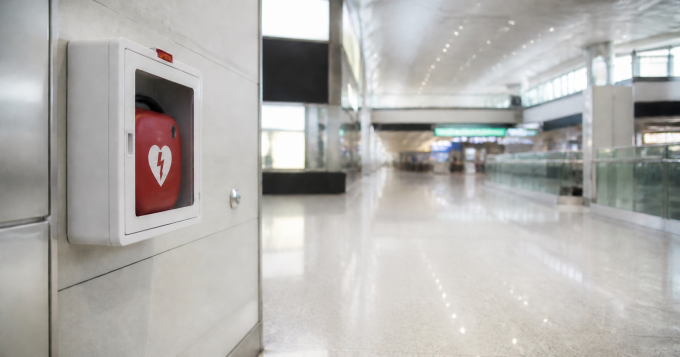
The New York City Department of Health recommends that organizations and businesses
keep shared naloxone in a location that is easy to find in an emergency, such as near a first-aid kit or an
AED. This does not mean distributing naloxone and AEDs as one kit; it means improving access so both can be
found quickly when needed.
NYC Health lists locations for free naloxone kits, including pharmacies,
opioid-overdose prevention programmes, and 24-hour public-health vending machines. In 2026, its “Just in
Case” campaign also promoted free mail delivery and online education.
Scope of this article
This is public-health information based on WHO materials and does not provide personal
diagnosis or treatment instructions. In an emergency involving reduced consciousness or breathing
difficulty, seek professional emergency help immediately.
Sources
International Overdose Awareness Day —
2026 campaign and August 31 information
World Health Organization,
Opioid overdose — updated August 29, 2025
US CDC, Drug Overdose Deaths in the
United States, 2023–2024
Public
Health Agency of Canada, Opioid toxicity deaths
American
Heart Association, 2025 CPR & ECC Guidelines: Opioids
US
FDA, first over-the-counter naloxone nasal spray
Health Canada,
Naloxone
UK Department
of Health and Social Care, Supplying take-home naloxone without a prescription
NYC Health, Naloxone
NYC
Health, “Just in Case” campaign