Emerging Markets
Singapore’s 2026 BCLS and AED Guidelines: What Has Changed?
No major overall change fr|om the 2021
edition
Singapore Medical Journal published Singapore Basic Cardiac Life Support and Automated External Defibrillation
Guidelines 2026 in July 2026. This is a guideline describing Singapore’s BCLS and AED
procedures, not a clinical study of a specific patient group.
Compared with the 2021 guideline fr|om the Singapore Resuscitation and First Aid
Council (SRFAC), there are no major changes to CPR performance overall. Changes were made to paediatric CPR
and foreign body airway obstruction in conscious adults and children.
Key changes in 2026
The paediatric compression-to-ventilation ratio is presented as 15:2, replacing the previous use of
30:2 or 15:2.
For infant chest compressions, either the two-thumbs-encircling technique or
the one-hand method is recommended.
Back blows have been reintroduced into the algorithm for conscious adults
and children with foreign body airway obstruction.
Gasping may be a sign of cardiac
arrest
The guideline describes recognition of cardiac arrest as one of the most difficult
parts of BCLS education and assessment. Studies cited in the guideline found gasping in up to 40% of
patients during the early phase of sudden cardiac arrest.
Lay rescuers and healthcare providers should learn to recognize gasping as a sign of
cardiac arrest rather than normal breathing and begin CPR immediately. If a person is unresponsive and
normal breathing is absent or uncertain, cardiac arrest should be presumed. A brief seizure may also occur
at the onset; once it stops, responsiveness and normal breathing should be checked and CPR started if
breathing is absent or uncertain.
Dispatcher-assisted CPR and
myResponder
Dispatcher-assisted CPR (DACPR) is associated with higher bystander CPR rates and
better survival after cardiac arrest. When callers report an unresponsive person with absent or abnormal
breathing, Singapore’s call-takers instruct them to stay on the line and provide CPR guidance.
For adults, instructions focus on compression-only CPR; for paediatric arrests,
chest compressions with ventilation are advised. Singapore’s myResponder app alerts community first responders within 400 metres and
guides them to retrieve the nearest AED while going to the scene.
Why compression-only CPR is
emphasized for lay rescuers
The guideline notes that most sudden out-of-hospital cardiac arrests occur in adults
and are cardiac in origin. Because oxygen remains in the blood for the first few minutes, uninterrupted
chest compressions are more important than rescue breaths at the start. Two observational studies cited in
the guideline found improved adult out-of-hospital cardiac arrest survival after compression-only CPR was
introduced in the community.
In a Singapore study, only 14.9% of participants trained in mouth-to-mouth
ventilation could perform at least five effective ventilations of 400 mL or more six months later, and 3.7%
could perform at least ten within five minutes. Another 14.9% only mimicked the ventilation. SRFAC therefore
recommends that lay-rescuer CPR training focus on recognizing cardiac arrest, calling an ambulance, and
delivering high-quality manual chest compressions.
Public access defibrillator
programmes remain a priority
The 2025 ILCOR Consensus on Science with Treatment Recommendations strongly
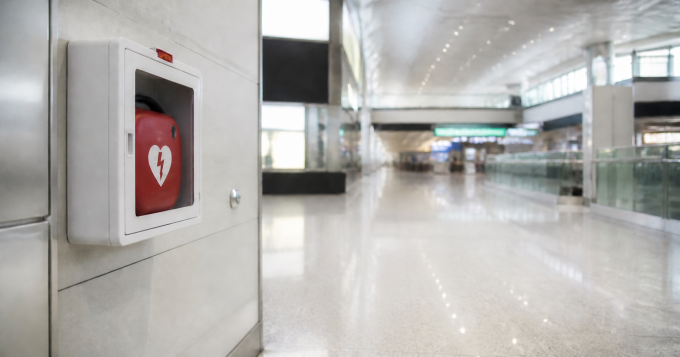
recommends public access defibrillator (PAD) programmes. The guideline reports that studies in residential
areas, airports, subways, casinos, and sports facilities associate PAD programmes with improved
out-of-hospital cardiac arrest survival.
In Singapore, the Singapore Heart Foundation and Singapore Civil Defence Force
provide an AED owner’s guide covering AED use, training, installation, and maintenance.
What Korean readers should
distinguish
The 995 emergency number, call-taker breathing checks, myResponder app, and course
arrangements reflect Singapore’s system. In Korea, the latest Korean CPR guidelines and emergency medical
system apply.
The way Singapore connects cardiac-arrest recognition, immediate dispatcher
guidance, community first responders, AED access, and repeatable layperson training is nevertheless a useful
point of reference for Korean educators. This is INNOSONIAN’s editorial interpretation based on the
guideline.
For training use
This article introduces key changes and re-emphasized points in the Singapore
guideline; it does not replace Korean medical guidance. Follow the latest local guidelines and advice
fr|om emergency medical professionals in training and real emergencies.
Paper information
Swee Han Lim, Benjamin Sieu-Hon Leong, Jun Hao Loke, Kee Chong Ng. Singapore
Basic Cardiac Life Support and Automated External Defibrillation Guidelines 2026. Singapore Medical
Journal. 2026;67(7):406–413.
PubMed · PMID 42507342
DOI:
10.4103/singaporemedj.SMJ-2026-319